
Why Conference Tables Matter in Today's Workplace Design
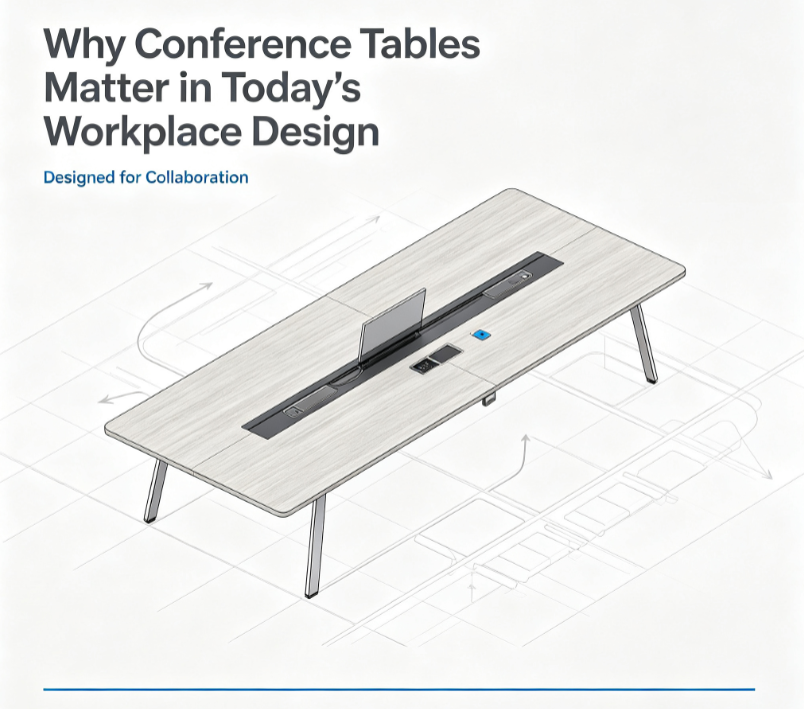
Table of Contents· Why Conference Tables Still Matter in the Hybrid Workplace· What Is a Conference Table?· How Conference Tables Influence Workplace Design· The Key Elements of a
Table of Contents
· Why Conference Tables Still Matter in the Hybrid Workplace
· What Is a Conference Table?
· How Conference Tables Influence Workplace Design
· The Key Elements of a High-Quality Conference Table
· Understanding Different Meeting Room Requirements
· Materials, Construction, and Durability
· Technology Integration in Modern Conference Tables
· Choosing the Right Conference Table for Your Business
· Industry Case Study
· FAQ
· Final Thoughts
Conference Rooms Have Changed—But the Table Is Still the Center of Every Important Conversation
Walk into almost any corporate headquarters, design studio, government office, or multinational company's meeting room.
You'll notice something interesting.
The displays have become larger. Video conferencing systems are smarter. Wireless presentation tools have replaced tangled cables. Even meeting styles have become more flexible.
Yet one thing hasn't disappeared.
The conference table remains the physical center of collaboration.
That's not by accident.
Whether a company is discussing annual budgets, introducing a new product, negotiating with international clients, or interviewing senior talent, important conversations still happen around a table. Even in hybrid workplaces, where remote participation is common, the meeting room continues to play a central role in business operations.
According to Gensler's Global Workplace Survey, employees consistently rank collaboration spaces among the most valuable areas in modern offices. At the same time, workplace research from Steelcase shows that organizations continue investing in meeting environments that encourage teamwork, creativity, and stronger communication.
That explains why businesses are paying closer attention to conference tables than they did a decade ago.
They're no longer selecting furniture based only on dimensions or price.
They're thinking about employee experience, technology compatibility, workplace flexibility, and long-term value.
What Is a Conference Table?
A conference table is a purpose-built meeting table designed to support collaboration, presentations, strategic discussions, client meetings, and team decision-making.
Unlike standard office desks, conference tables are engineered to accommodate multiple users while providing sufficient space for laptops, documents, presentation equipment, and communication devices.
Today's modern conference tables often include features such as:
· Integrated cable management
· Built-in power outlets
· USB charging ports
· Wireless charging modules
· Data connectivity
· Modular configurations
· Acoustic cable boxes
· Video conferencing compatibility
In many workplaces, the conference table has evolved from simple furniture into an integrated workspace solution.
More Than Furniture—It's Part of Your Brand
Here's something many companies overlook.
Clients rarely see your accounting software.
They don't inspect your warehouse.
They probably won't visit your production floor.
But they almost certainly will sit in your meeting room.
That means your conference room quietly communicates something about your company before anyone begins speaking.
A scratched laminate table from fifteen years ago sends one message.
A well-designed executive conference table with clean lines, quality materials, and integrated technology sends another.
Neither guarantees business success.
Still, workplace design influences perception far more than many organizations realize.
Research published by the International Facility Management Association (IFMA) suggests that workplace quality directly affects both employee satisfaction and visitor impressions.
The meeting room becomes part of the company's professional identity.
How Conference Tables Support Modern Workplace Design
Office design has shifted significantly over the past decade.
Open-plan offices encouraged spontaneous collaboration, while hybrid work introduced flexibility into where—and how—people work.
Interestingly, meeting rooms didn't disappear.
Instead, they became more intentional.
Companies now use conference spaces for activities that truly benefit from face-to-face interaction.
That changes what businesses expect from their furniture.
Encouraging Better Collaboration
Good collaboration isn't just about having talented people in the same room.
The physical environment matters.
Table size, seating layout, sightlines, and accessibility all influence how comfortably participants interact.
A poorly proportioned table may create barriers between attendees.
A well-designed one naturally encourages discussion.
For this reason, architects increasingly consider conference room furniture during the early stages of workplace planning rather than treating it as a final purchasing decision.
Supporting Hybrid Meetings
Few organizations operate entirely in person today.
Hybrid meetings have become part of everyday business.
This creates new requirements for conference tables.
Modern meeting rooms often need space for:
· Cameras
· Microphones
· Speaker systems
· Display screens
· Power connections
· Laptop charging
· Network access
Without proper cable management, even expensive meeting rooms quickly become cluttered.
That's one reason why conference tables with power and data integration have become increasingly popular among corporate buyers.
Making Better Use of Office Space
Office space has become more valuable.
Companies want meeting rooms that can accommodate different types of discussions without wasting square footage.
Rather than designing oversized boardrooms that remain empty most of the week, many businesses now choose flexible meeting spaces supported by appropriately sized conference tables.
It's a subtle shift—but an important one.
Furniture is beginning to adapt to how people actually work, not how offices operated twenty years ago.
The Key Elements of a High-Quality Conference Table
Not every conference table performs equally well over time.
Some maintain their appearance after years of daily use.
Others begin showing wear surprisingly quickly.
The difference usually comes down to construction quality rather than appearance alone.
Several factors deserve careful attention.
Structural Stability
Conference tables experience frequent use.
People lean on them.
Presentation equipment is placed on them.
Large meeting rooms often require moving chairs around the table multiple times every day.
A stable frame helps prevent wobbling, joint movement, and long-term structural fatigue.
Quality manufacturers typically use reinforced steel frames, engineered support systems, or solid hardwood construction depending on the design.
Surface Durability
The tabletop receives the most abuse.
Coffee cups.
Laptop movement.
Writing.
Presentation equipment.
Cleaning chemicals.
Over time, these everyday actions leave visible marks on inferior materials.
High-quality commercial conference tables generally feature surfaces designed to resist:
· Scratches
· Heat
· Moisture
· Stains
· Abrasion
· UV fading
Material selection plays a significant role here—a topic we'll explore in the next section.
Ergonomic Comfort
It's easy to focus on aesthetics and forget comfort.
Yet meeting participants may spend two or three hours around the same table.
Proper knee clearance, comfortable edge profiles, sufficient legroom, and appropriate table height all contribute to a better meeting experience.
Small ergonomic improvements often go unnoticed—until they're missing.
Built-In Technology Readiness
Technology is no longer optional in modern meeting rooms.
Conference tables increasingly serve as infrastructure rather than standalone furniture.
Common integrated features include:
· Flip-top cable boxes
· Hidden power modules
· USB-A and USB-C charging
· HDMI connections
· Ethernet access
· Wireless charging pads
These additions reduce visible cable clutter while supporting seamless presentations and video conferences.
A thoughtfully designed table helps technology disappear into the background, allowing meetings to stay focused on the conversation rather than the equipment.
Materials Shape Performance More Than Most Buyers Expect
It's easy to compare conference tables based on appearance.
The finish looks similar. The dimensions are close. The quotation isn't dramatically different.
But after three or five years of daily use, the differences become obvious.
One table still feels solid, the surface remains clean, and the cable management works exactly as intended.
Another begins to wobble. Edges chip. Scratches accumulate. Power modules loosen.
Most of those issues can be traced back to one decision made long before installation—the choice of materials.
For commercial office furniture, durability isn't just about looking good. It's about reducing maintenance costs, extending service life, and protecting a company's investment.
Choosing the Right Material for Conference Tables
Every conference table is built around a combination of core materials, surface finishes, and structural components.
Each option serves a different purpose depending on the workspace, budget, and expected usage.
Solid Wood
Solid wood remains the benchmark for executive boardrooms.
Materials such as oak, walnut, ash, and maple offer natural grain patterns that simply can't be replicated by synthetic surfaces.
More importantly, solid wood ages gracefully.
Minor scratches can often be repaired, and the surface can be refinished if necessary.
You'll typically see solid wood conference tables in:
· Executive offices
· Corporate headquarters
· Government buildings
· Luxury meeting rooms
· Law firms
· Financial institutions
The trade-off?
Higher cost and greater sensitivity to humidity if the material isn't properly treated.
Wood Veneer
Many premium conference tables actually use veneer rather than solid timber.
A wood veneer consists of a thin slice of real hardwood bonded to an engineered core.
When manufactured correctly, veneer offers several advantages:
· Consistent appearance
· Improved dimensional stability
· Lower material cost
· Reduced risk of warping
· Excellent premium aesthetics
For many commercial office projects, veneer provides an effective balance between appearance and budget.
High-Pressure Laminate (HPL)
If durability is the priority, laminate deserves serious attention.
Modern high-pressure laminate conference tables resist:
· Scratches
· Coffee stains
· Daily wear
· Cleaning chemicals
· Heat from laptops
· Surface abrasion
That's why laminate has become a favorite choice for:
· Training rooms
· Universities
· Public institutions
· Shared workspaces
· Large conference centers
Today's commercial laminates are also available in finishes that closely resemble natural wood.
Many people can't immediately tell the difference.
MDF with Decorative Finishes
Medium-density fiberboard (MDF) is frequently used as a stable substrate beneath veneer, laminate, or lacquer finishes.
Quality varies considerably.
High-density MDF combined with precision machining produces excellent furniture.
Low-density boards, however, may struggle under long-term commercial use.
That's why buyers should evaluate the complete construction—not simply ask whether MDF is used.
Metal Frames
The tabletop often receives most of the attention.
The frame shouldn't.
A conference table's stability depends heavily on its support structure.
Commercial-grade frames typically use powder-coated steel or aluminum because they provide:
· High structural strength
· Corrosion resistance
· Long service life
· Reduced movement during meetings
As conference tables become larger, engineered steel frames play an increasingly important role.
Which Material Works Best?
There's no universal answer.
The right choice depends on how the meeting room is actually used.
Material | Appearance | Durability | Maintenance | Typical Applications |
Solid Wood | Premium | Excellent | Moderate | Executive boardrooms |
Wood Veneer | High-end | Very Good | Easy | Corporate meeting rooms |
High-Pressure Laminate | Modern | Excellent | Very Easy | Daily commercial use |
MDF + Veneer | Professional | Good | Easy | General office environments |
Steel Frame | Industrial strength | Excellent | Minimal | Large conference tables |
Rather than asking, "Which material is best?" a better question is, "Which material fits our workplace?"
Planning the Right Conference Table Size
Choosing dimensions isn't simply about fitting the room.
It's about creating comfortable interaction.
A conference table that dominates the room leaves little circulation space.
One that's too small quickly feels overcrowded.
Interior designers generally recommend maintaining at least 900–1,200 mm (36–48 inches) of clearance between the table edge and surrounding walls or furniture. This allows chairs to move comfortably and people to walk around the room without disrupting a meeting.
As a general guideline:
Seating Capacity | Recommended Table Length |
4–6 people | 1.8–2.4 m (6–8 ft) |
6–8 people | 2.4–3.0 m (8–10 ft) |
8–10 people | 3.0–3.6 m (10–12 ft) |
10–14 people | 3.6–4.8 m (12–16 ft) |
14+ people | Custom modular solutions |
Of course, room shape matters just as much as table length. Long, narrow rooms often benefit from boat-shaped or oval tables, while square meeting rooms may work better with round or modular configurations.
Technology Integration Has Become Standard
A decade ago, conference tables mainly needed enough surface area for paper documents and notebooks.
Today's meetings are different.
Participants arrive carrying laptops, tablets, smartphones, wireless presentation devices, and charging cables. Hybrid meetings also require cameras, microphones, and display systems.
This has changed what buyers expect from modern conference tables.
Instead of adding power strips after installation, many companies now specify built-in technology from the beginning.
Common integrated features include:
Hidden Power Modules
Flip-top or soft-close access panels allow users to connect devices without leaving cables exposed across the tabletop.
USB Charging
USB-A and increasingly USB-C charging ports have become standard in premium meeting environments.
They eliminate the need for separate chargers while supporting mobile work.
Cable Management Systems
A well-designed cable management system keeps power cords, network cables, and HDMI connections hidden beneath the table.
Besides improving aesthetics, it also simplifies maintenance and reduces trip hazards.
Wireless Charging
Some manufacturers now integrate Qi-compatible wireless charging pads directly into conference tables.
Although not yet universal, demand is growing as mobile devices continue to support wireless charging.
Case Study: Microsoft's Hybrid Meeting Spaces
A practical example of conference table evolution can be seen in Microsoft's workplace redesign following the expansion of hybrid work.
Across several office campuses, meeting rooms were reconfigured to better support collaboration between in-person and remote participants. Furniture layouts, including conference tables, were selected to improve camera sightlines, provide integrated power access, and accommodate modern collaboration technologies such as Microsoft Teams Rooms.
Rather than treating the table as a standalone furnishing, Microsoft incorporated it into a broader workplace ecosystem where furniture, digital collaboration tools, and room technology function together.
This reflects a wider trend across corporate office design: conference tables are increasingly specified as part of an integrated meeting solution rather than purchased solely for appearance.
According to Steelcase and Gensler Workplace Surveys, organizations continue investing in flexible collaboration spaces because well-designed meeting environments support stronger teamwork, faster decision-making, and a better employee experience.
How to Choose the Right Conference Table Supplier
A conference table is usually expected to stay in service for 10 years or more. In many offices, it becomes one of the most heavily used pieces of furniture. People gather around it every day for meetings, presentations, interviews, negotiations, and client visits.
That long service life changes the buying process.
You're not simply purchasing a table. You're investing in a workspace asset that needs to perform consistently under daily commercial use.
So, what separates a reliable manufacturer from an average one?
It isn't just production capacity.
It's the ability to match furniture engineering with the way people actually work.
Look Beyond Appearance
Product photos rarely tell the whole story.
Two conference tables may look almost identical online, yet differ significantly in structural design, hardware quality, and material construction.
When evaluating suppliers, ask practical questions such as:
· What core material is used beneath the surface finish?
· Is the steel frame welded or bolted?
· What edge banding technology is applied?
· Are cable management systems tested before shipment?
· What is the tabletop load capacity?
· Can damaged components be replaced individually?
Manufacturers that openly discuss these details are generally more confident in their products.
Verify Manufacturing Standards
For commercial office furniture, quality consistency matters just as much as design.
Look for manufacturers that comply with internationally recognized standards such as:
· ISO 9001 – Quality Management System
· ISO 14001 – Environmental Management
· BIFMA Standards – Performance and safety testing for commercial furniture
· FSC® Certification – Responsibly sourced wood materials (where applicable)
If your project involves government procurement, education, healthcare, or multinational corporations, these certifications are often part of the purchasing requirements.
Evaluate Customization Capability
Modern workplaces rarely follow a standard floor plan.
Meeting rooms vary in shape, capacity, and technology requirements.
A capable supplier should be able to customize:
· Table dimensions
· Surface finishes
· Wood species
· Veneer colors
· Cable management systems
· Power modules
· Seating capacity
· Table shapes
· Leg configurations
· Branding elements
Customization isn't about making the table look different.
It's about ensuring the furniture fits the space instead of forcing the space to fit the furniture.
Common Buying Mistakes
After working on office furniture projects, a few purchasing mistakes appear again and again.
Fortunately, they're also easy to avoid.
Choosing Based Only on Price
Budget always matters.
But conference tables are used every working day.
A slightly higher investment in better construction often translates into years of additional service life.
The lowest quotation isn't always the lowest cost over time.
Ignoring Future Technology Needs
Many companies purchase furniture for today's meeting requirements.
Unfortunately, technology changes much faster than furniture.
Adding integrated power modules, cable management channels, and accessible service panels now can prevent expensive modifications later.
Planning ahead usually costs less than retrofitting.
Overlooking Maintenance
Glossy finishes may look impressive in a showroom.
In a busy office, however, fingerprints, scratches, and daily wear become much more noticeable.
Some commercial environments benefit more from matte laminates, textured veneers, or anti-fingerprint coatings.
Selecting finishes based on long-term maintenance—not just initial appearance—often results in lower ownership costs.
Buying Without Considering Room Acoustics
Here's something that's frequently overlooked.
Large conference tables influence how sound travels within a meeting room.
Table shape, surface material, and room layout all affect speech clarity, especially during hybrid meetings.
Many workplace designers now coordinate conference table selection with acoustic panels, ceiling treatments, and video conferencing systems to improve communication quality.
Trends Shaping Conference Tables in 2026
Office furniture continues to evolve alongside workplace expectations.
Several developments are influencing conference table design in 2026.
Hybrid Collaboration Is Driving Design
Hybrid work is no longer viewed as a temporary adjustment.
Many organizations now operate with employees joining meetings from different cities—or even different countries.
As a result, conference tables are being designed to improve camera angles, microphone placement, and participant visibility for video conferencing.
Furniture is becoming part of the communication system rather than simply supporting it.
Sustainability Is Becoming a Purchasing Requirement
Environmental performance has become an important evaluation factor for many corporate buyers.
Manufacturers are responding by introducing:
· FSC®-certified timber
· Low-VOC finishes
· Recycled aluminum components
· Environmentally responsible laminates
· Modular construction for easier repairs
· Replaceable tabletop components
Sustainable furniture isn't only about environmental responsibility.
Longer-lasting products also reduce replacement costs and material waste.
Modular Meeting Spaces
Traditional boardrooms remain important, but many companies now require spaces that can adapt throughout the day.
Modular conference tables allow organizations to reconfigure layouts for:
· Training sessions
· Workshops
· Client presentations
· Team brainstorming
· Board meetings
· Product demonstrations
That flexibility makes better use of office space while supporting different collaboration styles.
Smart Office Integration
Conference tables are becoming increasingly connected.
Emerging features include:
· Wireless charging zones
· Integrated occupancy sensors
· Smart cable routing
· Digital room booking indicators
· IoT-enabled power management
· Hidden docking stations
These technologies help reduce clutter while supporting more efficient meeting environments.
Frequently Asked Questions
What is the ideal size for a conference table?
The right size depends on the number of users, room dimensions, and circulation space.
As a general guideline, allow approximately 750–900 mm (30–36 inches) of table width per person and maintain at least 900 mm (36 inches) of clearance around the table for comfortable movement.
Which material is best for commercial conference tables?
There isn't a single best material.
Solid wood offers premium aesthetics and longevity, veneer provides a balance between appearance and cost, while high-pressure laminate delivers excellent durability for high-traffic environments.
The appropriate choice depends on how the meeting room will be used.
Are built-in power outlets worth the investment?
For most modern workplaces, yes.
Integrated power modules improve convenience, reduce visible cables, and support hybrid meetings by allowing participants to connect laptops, tablets, and other devices directly at the table.
How long should a quality conference table last?
A well-manufactured commercial conference table can remain in service for 10–20 years or longer with proper maintenance.
Material quality, structural engineering, and daily usage all influence its lifespan.
Final Thoughts
A conference table doesn't simply fill the center of a meeting room.
It influences how people collaborate, communicate, solve problems, and represent the company to clients and partners.
As workplaces continue to evolve, businesses are placing greater emphasis on furniture that combines durability, ergonomic comfort, technology integration, and flexible design.
Choosing the right conference table means looking beyond appearance.
Construction quality, materials, workspace planning, future technology compatibility, and long-term maintenance all deserve careful consideration.
When these factors come together, a conference table becomes more than furniture—it becomes part of a productive workplace strategy.
Interested in Learning More?
Contact our team to discuss how we can help with your furniture needs.
Get in Touch