
How to Select Steel Filing Cabinets & Storage: Cold-Rolled Steel Thickness (0.7mm vs. 1.2mm) & Locking Specs
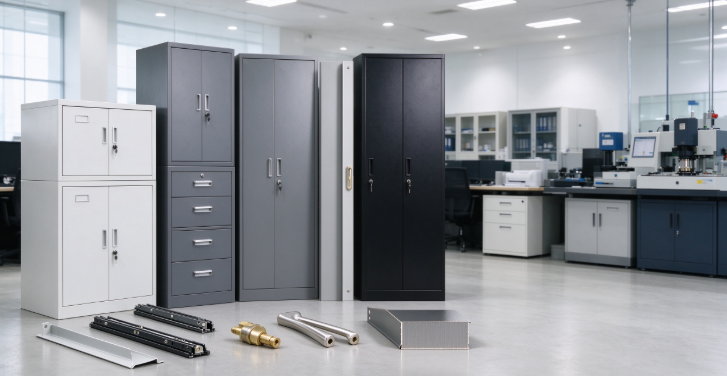
1. Introduction: The Specification That Decides How Long Your Cabinet LastsI have been sourcing steel filing cabinets and office storage for over a decade, and I can tell you that
1. Introduction: The Specification That Decides How Long Your Cabinet Lasts
I have been sourcing steel filing cabinets and office storage for over a decade, and I can tell you that the most expensive mistake in cabinet procurement is not choosing the wrong color or the wrong drawer configuration. It is choosing the wrong steel thickness.
A 0.7mm cabinet and a 1.2mm cabinet look identical in a catalog photo. They have the same powder coating, the same handles, and the same drawer count. But the 0.7mm cabinet will support a shelf load of 30–50 kg. The 1.2mm cabinet will support 150 kg or more. The 0.7mm cabinet will dent when a cart bumps into it. The 1.2mm cabinet will not. And the 0.7mm cabinet will start to rack — the frame twists and the drawers misalign — after a few years of heavy use. The 1.2mm cabinet will stay square for a decade.
The global office furniture market continues to expand, driven by commercial construction and workplace upgrades. But the steel thickness specification is not always fully understood by the buyers placing the orders. A millimeter is not a millimeter in this industry — the difference between 0.7mm and 1.2mm is the difference between a cabinet that lasts three years and one that lasts fifteen.
This guide breaks down the two thickness classes, the locking specifications, the safety standards, and the sourcing framework that matches the cabinet to the application.
2. What Cold-Rolled Steel Actually Is
Cold-rolled steel — designated SPCC (Steel Plate Cold Commercial) in the Chinese standard system — is the standard material for quality office cabinets. It is produced by rolling steel at room temperature, which gives it a smoother surface, tighter dimensional tolerances, and better surface finish than hot-rolled steel. The smooth surface is important because it accepts the powder coating evenly and produces the clean, flat appearance that commercial furniture requires.
SPCC cold-rolled steel has a tensile strength of approximately 270–410 MPa and a yield strength of approximately 150–250 MPa depending on the thickness and the rolling process. The material is easy to form, weld, and coat. It is the default choice for filing cabinets, storage lockers, and office pedestals across Asia and Europe.
The alternative — hot-rolled steel — is cheaper but has a rougher surface (scale and oxide are present after rolling) and wider thickness tolerances. It is not suitable for visible furniture surfaces. Cold-rolled steel is the correct specification for any cabinet that will be seen in an office environment.
Parameter | Cold-Rolled Steel (SPCC) | Hot-Rolled Steel |
Surface finish | Smooth, uniform | Rough, scale present |
Thickness tolerance | Tight (±0.02–0.05 mm) | Wider (±0.1 mm or more) |
Tensile strength | 270–410 MPa | 370–520 MPa |
Coating adhesion | Excellent | Requires surface prep |
Typical cabinet use | Standard for quality cabinets | Budget cabinets, hidden parts |
3. 0.7mm Steel: The Office Standard
0.7mm cold-rolled steel is the workhorse of the office filing cabinet industry. It is the thickness that most commercial cabinet manufacturers use as their baseline for standard office products, and it delivers an acceptable balance of cost, weight, and structural performance.
The load capacity. A 0.7mm steel cabinet with properly designed shelves and reinforcements delivers a shelf load capacity of 30–50 kg per shelf. This is adequate for standard office document storage — A4 paper, ring binders, archive boxes, and general office supplies. The shelf may deflect slightly under sustained load, but it will not fail.
The structural rigidity. 0.7mm steel provides enough stiffness to keep the cabinet frame square under normal use. The doors and drawers open and close smoothly, and the cabinet does not rack or twist under moderate loads. However, the thin gauge is vulnerable to denting from impact — a trolley bumping into the side panel, a box dropped against the door, or a foot kicking the base.
Where it works. 0.7mm is the correct specification for general office environments — administration offices, HR departments, accounting offices, and any application where the cabinet will be loaded with standard paper files and handled with reasonable care.
Where it fails. 0.7mm is not suitable for heavy loads, industrial environments, or anywhere the cabinet will be subjected to rough handling. A 0.7mm cabinet that is overloaded with dense files or bumped repeatedly will develop dents, misaligned drawers, and eventually structural failure.
4. 1.2mm Steel: The Heavy-Duty Specification
1.2mm cold-rolled steel is the heavy-duty specification. It is approximately 70% thicker than 0.7mm steel, and that additional thickness changes every performance metric.
The load capacity. A 1.2mm steel cabinet with reinforced shelves delivers a shelf load capacity of 150–250 kg per shelf. This is three to five times the capacity of a 0.7mm cabinet. The shelf does not bow under heavy loads, and the frame remains rigid even when every shelf is fully loaded with dense engineering drawings, archived records, or heavy equipment.
The impact resistance. The thicker gauge resists denting far better than 0.7mm steel. A 1.2mm cabinet will survive a cart impact, a dropped box, or a kicked base without visible damage. The surface stays flat and the paint stays intact. In high-traffic environments — warehouses, workshops, hospital back-offices — this durability is the difference between a cabinet that still looks professional after five years and one that looks battered after one.
The racking resistance. Racking is the twisting of the cabinet frame that causes drawers to misalign and locks to fail. Thin steel cabinets are prone to racking under heavy loads or uneven floors. The 1.2mm frame resists racking because the thicker steel has higher bending stiffness. The drawers stay aligned, the locking bars stay engaged, and the cabinet functions as designed for years.
Where it works. 1.2mm is the correct specification for heavy-duty applications — warehouses, factory floors, hospital record rooms, government archives, and any environment where the cabinet will be loaded heavily or handled roughly.
5. Head-to-Head: Thickness Comparison Table
Parameter | 0.7mm Cold-Rolled Steel | 1.2mm Cold-Rolled Steel |
Nominal thickness | 0.7 mm | 1.2 mm |
Approximate gauge equivalent | 22-gauge (0.75 mm) | 18-gauge (1.21 mm) |
Shelf load capacity | 30–50 kg per shelf | 150–250 kg per shelf |
Dent resistance | Moderate — dents under impact | High — resists impact |
Racking resistance | Moderate — may rack under heavy load | High — frame stays square |
Door alignment stability | Good under normal use | Excellent under all conditions |
Lock mechanism stability | Good | Excellent — thicker steel holds alignment |
Weight (typical 4-drawer cabinet) | 35–45 kg | 55–75 kg |
Relative cost | Baseline | +40–70% |
Best application | General office, standard document storage | Warehouse, archive, hospital, industrial |
Expected service life | 5–8 years | 10–15+ years |
6. Steel Gauge vs. Millimeter: Reading the Spec Correctly
The steel furniture industry uses two systems to describe thickness: millimeters (the metric standard used in Asia and Europe) and gauge numbers (the Imperial standard used in North America). The gauge system is counterintuitive — the lower the gauge number, the thicker the steel.
The conversion for cold-rolled steel is:
Gauge | Approximate Thickness (mm) | Typical Cabinet Application |
24-gauge | 0.60 mm | Light-duty, budget cabinets |
22-gauge | 0.75 mm | Standard office cabinets |
20-gauge | 0.91 mm | Mid-heavy-duty cabinets |
18-gauge | 1.21 mm | Heavy-duty, industrial cabinets |
The critical sourcing warning is that some suppliers quote the thickness after powder coating, not the bare steel thickness. The powder coating adds approximately 0.05–0.10 mm to the measured thickness. A cabinet advertised as "0.8mm" may actually have 0.6mm bare steel plus 0.2mm of coating. The bare steel thickness is the specification that determines structural performance. Always ask for the bare steel thickness and specify a minimum bare steel thickness in the purchase order.
7. Locking Specifications: Cam Lock, Cylinder Lock, and Central Interlock
The locking system determines the security level and the operational convenience of the cabinet. Three locking configurations dominate the market.
Cam lock. The cam lock is the standard lock for steel filing cabinets. A rotating cam engages with a locking bar or a drawer slot when the key is turned. Cam locks are simple, reliable, and inexpensive. They are available in keyed-alike configurations (multiple locks operated by the same key) and keyed-different configurations. The limitation is that a cam lock secures only the drawer or door where it is mounted unless it is connected to a locking bar system.
Cylinder lock (pin tumbler). The cylinder lock uses a pin tumbler mechanism similar to a door lock. It offers better pick resistance than a basic cam lock and is available with anti-drill and anti-pick features for higher-security applications. Cylinder locks are commonly found in office furniture and server racks.
Central interlock system (anti-tilt lock). The central interlock is the most important locking feature for multi-drawer cabinets. It ensures that only one drawer can be opened at a time. When one drawer is pulled open, the interlock mechanism locks the other drawers in the closed position. This prevents the cabinet from tipping forward when a heavy drawer is fully extended — a critical safety feature that is required by ANSI/BIFMA standards.
The interlock system is not just a convenience feature. It is a tipping prevention mechanism. A cabinet with three loaded drawers and no interlock can tip forward when the top drawer is opened. The interlock eliminates that risk.
Keying options. For multi-cabinet installations, the keying configuration matters. The standard options are:
Keyed-alike — all cabinets in a department open with the same key
Keyed-different — each cabinet has its own unique key
Master-keyed — a hierarchical system where a master key opens all cabinets and individual keys open specific cabinets
For office environments with multiple cabinets, keyed-alike or master-keyed systems simplify key management and reduce the number of keys that staff need to carry.
8. Safety Standards: ANSI/BIFMA and Load Testing
The ANSI/BIFMA X5.3 and X5.5 standards define the performance requirements for filing cabinets and storage furniture. These are the standards that professional procurement specifications should reference.
The interlock test. The standard specifies that when one drawer is pulled open, the other drawers must not open more than 12.5mm beyond the front face of the cabinet. This test verifies that the interlock mechanism is functioning correctly and that the cabinet will not tip.
The lock test. The cabinet is loaded with an evenly distributed weight, the drawers are closed and locked, and a horizontal outward pull of 220 N is applied to the drawer pull. The drawer must not open, and the locking mechanism must operate properly after the test.
The stability test. The cabinet is placed on a hard, level surface, and the drawers are loaded with an evenly distributed weight. The standard specifies the loading conditions and the acceptance criteria for tip-over resistance.
The racking resistance test. The cabinet frame is subjected to lateral forces to verify that it does not twist or rack under load. This test is particularly important for thin-gauge cabinets, which are more prone to racking than heavy-gauge units.
9. Application Matching: Which Thickness for Which Environment
Environment | Load Profile | Handling | Recommended Thickness | Rationale |
General office (admin, HR) | Light to medium — A4 paper, binders | Careful | 0.7 mm | Adequate for standard documents |
Accounting / legal office | Medium to heavy — dense files, ledgers | Moderate | 0.7–0.9 mm | Slightly thicker for dense loads |
Hospital records room | Heavy — thick patient files | Moderate | 0.9–1.2 mm | Heavy loads, frequent access |
Warehouse / factory floor | Heavy — tools, parts, drawings | Rough | 1.2 mm | Impact resistance required |
Government archive | Heavy — long-term document storage | Infrequent but loaded | 1.2 mm | Maximum load capacity and durability |
School / university | Medium — student records | Moderate to rough | 0.9–1.2 mm | Balance of cost and durability |
Laboratory | Light — samples, small equipment | Careful | 0.7 mm | Standard storage |
10. Practical Sourcing Framework for B2B Buyers
If you are sourcing steel filing cabinets for a commercial project, here is the framework I recommend.
Step 1: Calculate the actual load per shelf. Weigh a typical full load of the documents or items that will be stored. A shelf full of A4 paper weighs approximately 25–35 kg. A shelf full of ring binders weighs 30–45 kg. A shelf full of dense engineering drawings or archived records can weigh 50–80 kg. The load determines the minimum thickness.
Step 2: Specify the bare steel thickness, not the coated thickness. The powder coating adds 0.05–0.10 mm to the measured thickness. Specify the minimum bare steel thickness in the purchase order. Require the supplier to provide a mill certificate or a micrometer measurement of the bare steel.
Step 3: Specify the interlock requirement. For any cabinet with three or more drawers, specify a central interlock system that prevents more than one drawer from opening at a time. This is a safety requirement, not an option.
Step 4: Specify the keying configuration. For multi-cabinet installations, decide between keyed-alike, keyed-different, and master-keyed. Keyed-alike is the most practical for departments. Master-keyed is the most flexible for facilities management.
Step 5: Require ANSI/BIFMA compliance documentation. The supplier should provide test data showing that the cabinet meets ANSI/BIFMA X5.3 or X5.5 for stability, interlock function, lock security, and racking resistance.
Step 6: Verify the drawer slide specification. The drawer slides determine how smoothly the drawer opens and how long the mechanism lasts. For heavy-duty applications, specify ball-bearing slides rated for 80,000–100,000 cycles rather than the standard 30,000–50,000 cycles.
Step 7: Inspect the welding and surface finish. The welding at the cabinet corners and drawer frame determines the structural integrity. The powder coating should be uniform and free of runs, orange peel, or bare spots. A poorly welded cabinet will rack and fail regardless of the steel thickness.
Sourcing Parameter | General Office | Heavy-Duty |
Bare steel thickness | ≥0.7 mm | ≥1.2 mm |
Shelf load capacity | ≥35 kg | ≥150 kg |
Interlock system | Required for 3+ drawers | Required for 3+ drawers |
Drawer slides | Standard ball-bearing | Heavy-duty ball-bearing, 80k+ cycles |
ANSI/BIFMA compliance | Required | Required |
Keying configuration | Keyed-alike | Master-keyed |
Surface finish | Electrostatic powder coat | Electrostatic powder coat |
11. Frequently Asked Questions
Q: What is the difference between 0.7mm and 1.2mm steel filing cabinets?
0.7mm steel is the standard office specification with a shelf load capacity of 30–50 kg. 1.2mm steel is the heavy-duty specification with a shelf load capacity of 150–250 kg. The 1.2mm cabinet is approximately 70% thicker and costs 40–70% more. The thicker cabinet resists denting and racking far better than the 0.7mm cabinet.
Q: How do I know if a cabinet is actually 0.7mm thick?
Measure the bare steel with a micrometer, not the coated surface. The powder coating adds 0.05–0.10 mm. A cabinet advertised as "0.8mm" may have 0.6mm bare steel. Ask the supplier for the bare steel thickness specification and verify it with a micrometer on delivery.
Q: What is an interlock system and why does it matter?
An interlock system ensures that only one drawer can be opened at a time. It prevents the cabinet from tipping forward when a heavy drawer is fully extended. For any cabinet with three or more drawers, the interlock is a safety requirement under ANSI/BIFMA standards.
Q: What is the difference between a cam lock and a cylinder lock?
A cam lock uses a rotating cam to engage the locking bar. It is simple and inexpensive. A cylinder lock uses a pin tumbler mechanism similar to a door lock. It offers better pick resistance and is available with anti-drill features. Both are suitable for office cabinets. The cylinder lock is the better choice for higher-security applications.
Q: What keying options are available for steel filing cabinets?
The standard options are keyed-alike (all cabinets open with the same key), keyed-different (each cabinet has a unique key), and master-keyed (a master key opens all cabinets and individual keys open specific cabinets). Keyed-alike is the most practical for office departments. Master-keyed is the most flexible for facilities management.
Q: How long does a 0.7mm steel cabinet last compared to a 1.2mm cabinet?
A 0.7mm cabinet in a general office environment lasts approximately 5–8 years. A 1.2mm cabinet in the same environment lasts 10–15 years or more. In a heavy-duty environment, the difference is even more pronounced — the 0.7mm cabinet may fail within 3 years while the 1.2mm cabinet lasts a decade.
Q: What is the ANSI/BIFMA standard for filing cabinets?
ANSI/BIFMA X5.3 is the standard for vertical filing cabinets. It covers stability, interlock function, lock security, drawer cycling, and racking resistance. ANSI/BIFMA X5.5 covers desk and table products. A compliant cabinet should meet or exceed these standards.
Q: Does the powder coating thickness affect the steel thickness specification?
Yes. The powder coating adds 0.05–0.10 mm to the measured thickness. A cabinet with 0.6mm bare steel and 0.1mm coating will measure 0.7mm but is structurally a 0.6mm cabinet. Always specify the bare steel thickness, not the coated thickness.
12. Final Thoughts
The choice between 0.7mm and 1.2mm cold-rolled steel is not a choice between a good cabinet and a bad one. It is a choice between a cabinet that meets the needs of a general office and one that survives the demands of a heavy-duty environment. The 0.7mm cabinet is the correct specification for standard document storage. The 1.2mm cabinet is the correct specification for warehouses, archives, and any application where the load is heavy and the handling is rough.
The data is clear. A 0.7mm cabinet supports 30–50 kg per shelf. A 1.2mm cabinet supports 150–250 kg per shelf. The 1.2mm cabinet costs 40–70% more but lasts two to three times longer in a demanding environment. And the interlock system — the mechanism that prevents the cabinet from tipping — is a safety requirement regardless of which thickness you choose.
Interested in Learning More?
Contact our team to discuss how we can help with your furniture needs.
Get in Touch