
How Executive Desks Improve Productivity and Office Branding
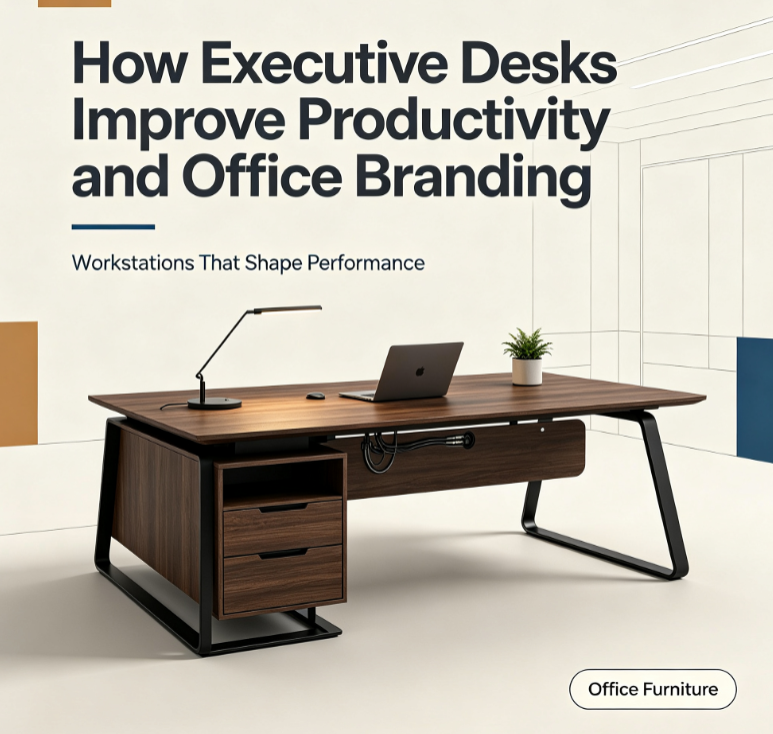
Table of Contents1. Why Executive Desks Matter More Than Ever2. The Productivity Case for a Better Desk3. Executive Desks as a Branding Asset4. Key Design Features That Drive Perfo
Table of Contents
1. Why Executive Desks Matter More Than Ever
2. The Productivity Case for a Better Desk
3. Executive Desks as a Branding Asset
4. Key Design Features That Drive Performance
5. Material Selection and What It Communicates
6. Technology Integration in Modern Executive Desks
7. Emerging Trends in Executive Desk Design
8. Real-World Project Example
9. Frequently Asked Questions
10. Final Thoughts
1. Why Executive Desks Matter More Than Ever
I've spent enough time around office furniture to notice something interesting.
People spend a lot of time talking about office chairs. Ergonomics, lumbar support, adjustability—all important, no question. But the desk? Often treated as an afterthought.
That's changing.
The global office furniture market was valued at USD 67.8 billion in 2025 and is expected to reach USD 90 billion by 2034. Within that, the executive desk segment alone is projected to grow from USD 6.53 billion in 2025 to USD 8.7 billion by 2035. That's not just inflation. That's organizations recognizing that where leaders work matters.
Here's what's driving this.
First, the return-to-office dynamic has shifted. JLL reported in 2026 that 62% of organizations now mandate fixed in-office days, up from 49% a year earlier. More people are coming back, and they're expecting better environments when they do.
Second, the hybrid work model has changed expectations. Gensler's 2025 Global Workplace Survey found that workplace experience is now a "top driver of retention," as poor office design can cause employees to feel disconnected from their environment. That applies to leadership too—maybe even more so, since executives spend a disproportionate amount of time in the office.
Third, there's the productivity angle. Research by facilities management company Mitie estimates UK employers suffer £485 million in lost hours every week due to workplace inefficiencies. Close to two thirds of people in executive leadership positions say inefficiencies in the workplace are consuming their days.
The desk is where those inefficiencies either get amplified or eliminated.
2. The Productivity Case for a Better Desk
Let me be direct about this.
A poorly designed executive desk doesn't just look bad. It actively works against you.
I've walked into executive offices where the desk was too small for the work being done. Laptops perched on the edge. Papers stacked in precarious towers. Cables snaking everywhere. The person behind it looked uncomfortable—because they were.
The productivity impact is measurable.
Employees surveyed reported that they can access 46% less focus time than they report needing. Executives top this figure with 4.5 hours per week of lost focus time. Four and a half hours. That's nearly a full working day every week lost to distractions and poor workspace design.
A properly specified executive desk addresses several productivity killers at once.
Workspace Organization
Clutter is a cognitive drag. Every item on a desk that doesn't belong there is a tiny distraction. A well-designed executive desk provides dedicated spaces for everything—computer, documents, phone, writing materials—so the executive can focus on decisions rather than searching for things.
Ergonomic Support
This is where executive desks have evolved significantly. Today's high-end executive desks increasingly feature height-adjustable mechanisms that allow users to alternate between sitting and standing positions. According to Mordor Intelligence, height-adjustable desks and tables are projected to expand at an 8.45% CAGR through 2031.
The reason is straightforward: prolonged sitting is bad for you, but so is prolonged standing. The ability to change position throughout the day reduces fatigue, improves circulation, and maintains focus.
Adequate Surface Area
One of the most common complaints I hear from executives is that their desk isn't big enough. Not for ego reasons—for practical ones. Multiple monitors, documents, a phone, perhaps a notepad—it adds up. An executive desk that's too small forces compromises that slow down work.
Integrated Cable Management
This sounds trivial until you've dealt with it. Tangled cables under a desk are more than an eyesore. They make cleaning difficult, they create trip hazards, and they make it harder to reconfigure the workspace when needed. Modern executive desks incorporate cable management systems that keep wires organized and out of sight.
3. Executive Desks as a Branding Asset
Here's something that surprises a lot of buyers.
The executive desk is often the first thing a visitor sees when entering a leadership office. Before any conversation happens, before any handshake, the desk has already communicated something about the organization.
The question is: what is it communicating?
A worn-out, generic desk from a discount office supplier says something very different from a thoughtfully selected executive desk that reflects the organization's values and aesthetic.
First Impressions Matter
Visitors form impressions quickly. The executive office—and the desk at its center—signals what the organization values. Is it quality? Innovation? Tradition? Sustainability? The desk answers that question before the executive says a word.
Brand Consistency
Organizations spend millions on logos, websites, and marketing materials to build brand identity. Then they put their leaders in offices that look nothing like the brand. It's a disconnect that undermines everything else.
A well-chosen executive desk extends brand identity into the physical workspace. A tech company might choose a sleek, minimalist desk with integrated technology. A law firm might opt for a traditional wooden desk that conveys stability and authority. A design firm might select something more sculptural and unconventional.
Talent Attraction and Retention
This one's easy to overlook.
Top talent has options. When candidates visit an office, they're evaluating more than the job description. They're evaluating whether this is a place they'd want to work. The quality of the workspace—including executive offices—signals how the organization treats its people.
Gensler's research found that workplace experience is now a top driver of retention. If the executive office feels thoughtful and well-designed, it suggests the organization thinks carefully about its people.
4. Key Design Features That Drive Performance
Not every executive desk is created equal. The differences that matter aren't always visible in a product photo.
Desk Configuration
Executive desks come in several configurations:
Rectangular – The classic shape. Works well in traditional offices and provides a clear separation between the executive and visitors.
L-shaped – Offers more surface area and creates a natural division between computer work and paperwork. Popular in modern executive offices.
U-shaped – Maximum surface area. Suitable for executives who need to spread out documents or who use multiple monitors.
Height-adjustable – Increasingly common in executive settings. Allows the user to alternate between sitting and standing throughout the day.
The right configuration depends on the executive's work style and the office layout.
Storage Integration
A desk that forces everything onto the surface is a desk that stays cluttered. Integrated storage—drawers, shelves, compartments—keeps essentials accessible while maintaining a clean workspace.
Surface Finish
The finish affects more than appearance. A high-gloss finish looks impressive but shows fingerprints and scratches. A matte finish is more forgiving but may feel less premium. The choice depends on the balance between aesthetics and practicality.
5. Material Selection and What It Communicates
Material choices are never neutral. Every material says something.
Solid Wood
Solid wood remains the gold standard for executive desks. Species like American walnut, European oak, and Australian spotted gum convey stature, stability, and authenticity. Wood desks age well, developing character over time. They're also expensive and heavy—which, in some contexts, is exactly the point.
Wood Veneers
Veneers offer the look of wood at a lower cost and with greater dimensional stability. High-quality veneers can be difficult to distinguish from solid wood. The key difference is that veneers can't be refinished as many times.
Metal and Glass
Modern executive desks increasingly combine materials. Metal frames with glass tops create a contemporary, transparent feel. This approach works well in tech and creative industries where innovation and openness are valued.
Laminate
High-pressure laminates offer durability and design flexibility at a lower price point. They're resistant to scratches and stains, making them practical for high-use environments. The trade-off is that they don't convey the same prestige as natural materials.
Mixed Materials
Increasingly, designers are combining materials within a single desk. A wooden top on a metal base. A glass surface with wooden accents. These combinations allow organizations to balance aesthetics, durability, and budget.
6. Technology Integration in Modern Executive Desks
Technology integration has become a defining feature of premium executive desks.
The old approach was to treat technology as an add-on. A monitor here, a cable there, a power strip somewhere underneath. The result was clutter.
The new approach is to embed technology into the desk itself.
Built-in Charging
Wireless charging pads integrated into the desk surface. USB-C ports flush with the edge. These features eliminate the need for separate chargers and reduce cable clutter.
Cable Management
Hidden cable channels keep wires organized and out of sight. Some desks include fabric-covered cable channels integrated into the tabletop. Others use under-desk cable trays that keep everything tidy.
Height Adjustment
Electric height-adjustable mechanisms allow executives to change position throughout the day. Premium systems operate quietly and can lift significant weight—the Herman Miller Spout, for example, achieves a lift capacity of up to 400 lbs.
Smart Features
Some executive desks now include posture reminders, app integration, and occupancy sensors. These features support health and productivity while signaling that the organization is forward-thinking.
7. Emerging Trends in Executive Desk Design
The executive desk is evolving. Several trends are shaping what we'll see in 2026 and beyond.
Sustainability as a Design Driver
Environmental considerations are increasingly influencing material selection. Manufacturers are using E1-grade, FSC-sourced materials and precision steelwork. Buyers are asking where materials come from and how they're produced.
The Decline of the "Barrier" Desk
Traditional executive desks were designed as barriers. Large, imposing surfaces that created physical and psychological distance between the executive and visitors.
That's changing. Designers are moving toward systems that facilitate collaboration rather than creating barriers. Instead of an oversized surface that creates distance, we're seeing elegant, minimalist systems that provide flexible meeting space within the office itself.
Biophilic Design Elements
Natural materials, organic forms, and connections to nature are increasingly influencing executive desk design. This reflects broader trends in office design toward creating spaces that feel human rather than institutional.
Personalization
Executives want desks that reflect their individual work styles and preferences. This drives demand for customization in size, materials, finishes, and technology integration.
8. Real-World Project Example
Let me share a project that illustrates what's possible.
The Neminath Office in Rajkot, India, designed by IKS Architects, features what the designers describe as a "bold and sculptural executive desk". The desk serves as an iconic centerpiece with its semi-cylindrical form, finished in rich terracotta tones and supported on gold-finished elliptical legs.
What I find instructive about this project is how the desk functions as more than furniture. It's described as "the perfect marriage of bold design and graceful structure," with a floating illusion created by the leg detailing that imparts "a sense of lightness to an otherwise grounded form".
The desk doesn't just hold a computer. It anchors the entire office design. It communicates something about the organization—confidence, sophistication, attention to detail.
And it works because it was designed as part of a complete space, not purchased as an afterthought.
9. Frequently Asked Questions
What makes a desk an "executive" desk?
Executive desks are typically larger, made with higher-quality materials, and designed with more attention to detail than standard office desks. They often include features like integrated storage, premium finishes, and ergonomic adjustments. The term refers more to the quality and positioning of the desk than to any specific feature.
How much should I budget for an executive desk?
Budgets vary widely. Entry-level executive desks start around USD 500–1,000. Mid-range options typically run USD 1,500–5,000. Premium executive desks—particularly those using solid wood or custom designs—can exceed USD 10,000. The right budget depends on the organization's needs and the statement the desk needs to make.
Are height-adjustable executive desks worth the investment?
For many executives, yes. The ability to alternate between sitting and standing throughout the day reduces fatigue, improves circulation, and maintains focus. Height-adjustable desks are one of the fastest-growing segments in the executive desk market, projected to grow at an 8.45% CAGR through 2031.
What's the most durable material for an executive desk?
Solid wood and high-pressure laminate are both highly durable. Solid wood can be refinished multiple times, extending its life significantly. Laminate resists scratches and stains but can't be refinished. For extreme durability, some manufacturers use steel-reinforced structures combined with wood or laminate surfaces.
How important is the desk to office branding?
More important than many organizations realize. The executive desk is often the first thing visitors see in a leadership office. Before any conversation happens, the desk has communicated something about the organization's values, quality standards, and attention to detail.
10. Final Thoughts
If there's one thing I've learned from years in this industry, it's this: the executive desk is not a commodity.
The global executive desk market is growing at a steady rate—2.9% CAGR from 2025 to 2035. That growth isn't happening because organizations enjoy spending money on furniture. It's happening because they've realized that where leaders work affects how they work.
A well-designed executive desk improves focus by eliminating clutter and providing adequate workspace. It supports health through ergonomic features like height adjustment. It communicates brand values through material selection and design. And it creates a lasting impression on everyone who enters the office.
The key is to approach the executive desk as a strategic investment, not a procurement exercise.
That means understanding how the executive actually works. Considering the impression the office needs to make. Evaluating materials for both aesthetics and durability. Planning for technology integration. And thinking about how the desk fits into the broader office design.
Organizations that take this approach consistently see better productivity, stronger branding, and more satisfied leaders.
And in today's competitive environment, that's worth more than saving a few hundred dollars on a desk.
Interested in Learning More?
Contact our team to discuss how we can help with your furniture needs.
Get in Touch